Attracting and Retaining Talent in Community Association Management
Community association management offers meaningful work, strong opportunities for advancement, and the chance to improve the communities people call home. Yet the profession continues to face significant recruitment and retention challenges—including limited public awareness, demanding workloads, and changing expectations around compensation, flexibility, and workplace support.
The Foundation’s research examines how professionals enter the field, what motivates them to stay, and how employers and community association leaders can build a stronger talent pipeline.
What We Learned in 2026
In January 2026, the Foundation surveyed 201 community association professionals across 34 states, revisiting many of the questions explored in its original 2021 research. The findings show that community association management remains a rewarding career built around service, problem-solving, leadership, and continual learning. They also reveal an ongoing need to increase awareness of the profession and create work environments that support long-term success.

%
Were unaware the profession existed before applying
%
Say employee referrals are the most successful recruiting method
%
Were initially attracted by advancement opportunities
%
Say competitive pay and bonuses are most attractive to new hires
%
Encourage others to become community association managers
%
Identify high stress or workload as the greatest recruitment barrier
How People Find the Profession
Community association management is still frequently discovered by chance rather than through an established career pipeline. Thirty percent of respondents first learned about the profession through a friend or relative, while others entered through job boards, board or committee service, employee referrals, or previous work in related fields.
Professionals come from remarkably diverse backgrounds—including real estate, retail, hospitality, multifamily housing, education, health care, construction, finance, government, and nonprofit organizations. This creates a broad pool of candidates with transferable skills, but employers must help prospective managers understand the profession and recognize how their experience applies.
What Attracts—and Keeps—Talent
Career growth has become an increasingly important recruitment message. In 2026, advancement opportunities surpassed job stability as the leading reason respondents were attracted to their first community management position.
When considering a new position, professionals place the greatest value on:
- Good pay
- Work-life balance
- Income growth potential
- A role that matches their talents and skills
- Competitive benefits
- Remote or flexible work options
- Opportunities for advancement and professional development
The workplace itself matters, too. Ninety-six percent consider the work environment very or extremely important, followed by job stability at 93% and teamwork at 87%.
Meaningful Work—and Real Challenges
Managers describe the profession as demanding, complex, and deeply rewarding. Their strongest sources of job satisfaction are solving problems, helping people, experiencing variety in their work, leading others, and mentoring colleagues.
At the same time, unreasonable homeowner and board demands, micromanagement, evening meetings, lack of appreciation, and poor work-life balance can contribute to burnout and turnover. Addressing these challenges is essential to retaining experienced professionals and creating a sustainable management workforce.
“This is the hardest profession you’ll ever love—challenging, demanding, and deeply rewarding.”
Strategies for Employers
The research points to several practical steps management companies and community associations can take:
Promote community management as a distinct, purpose-driven career
Build employee-referral and professional-network recruitment programs
Recruit candidates from fields with transferable service, leadership, financial, and operational skills
Provide clear advancement pathways and invest in CAI education and credentials
Offer competitive compensation, strong benefits, and appropriate workplace flexibility
Establish formal onboarding, mentoring, and career-development programs
Set realistic workloads and clarify the respective roles of managers, boards, and homeowners
Create a culture in which professional expertise is respected and strong performance is recognized
Explore the Research
Compare the Foundation’s original national study with its latest findings on how the profession and workplace expectations have evolved.
2026 Snap Survey
The latest survey examines how professionals enter the field, what they value in the workplace, what contributes to job satisfaction and dissatisfaction, and how employers can attract and retain talent.

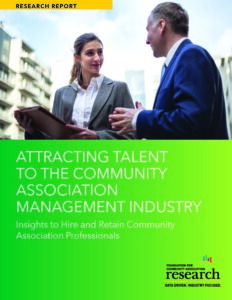
2021 Research Report
The Foundation’s original national study surveyed nearly 700 management professionals and hiring leaders. It explored the manager shortage, recruiting practices, transferable career backgrounds, workplace benefits, professional motivations, and barriers to retention.
2021 Project Acknowledgments
The Foundation gratefully recognizes the sponsors and volunteer task force members whose support and expertise made the original 2021 research possible.