
Housing Costs & Affordability by State
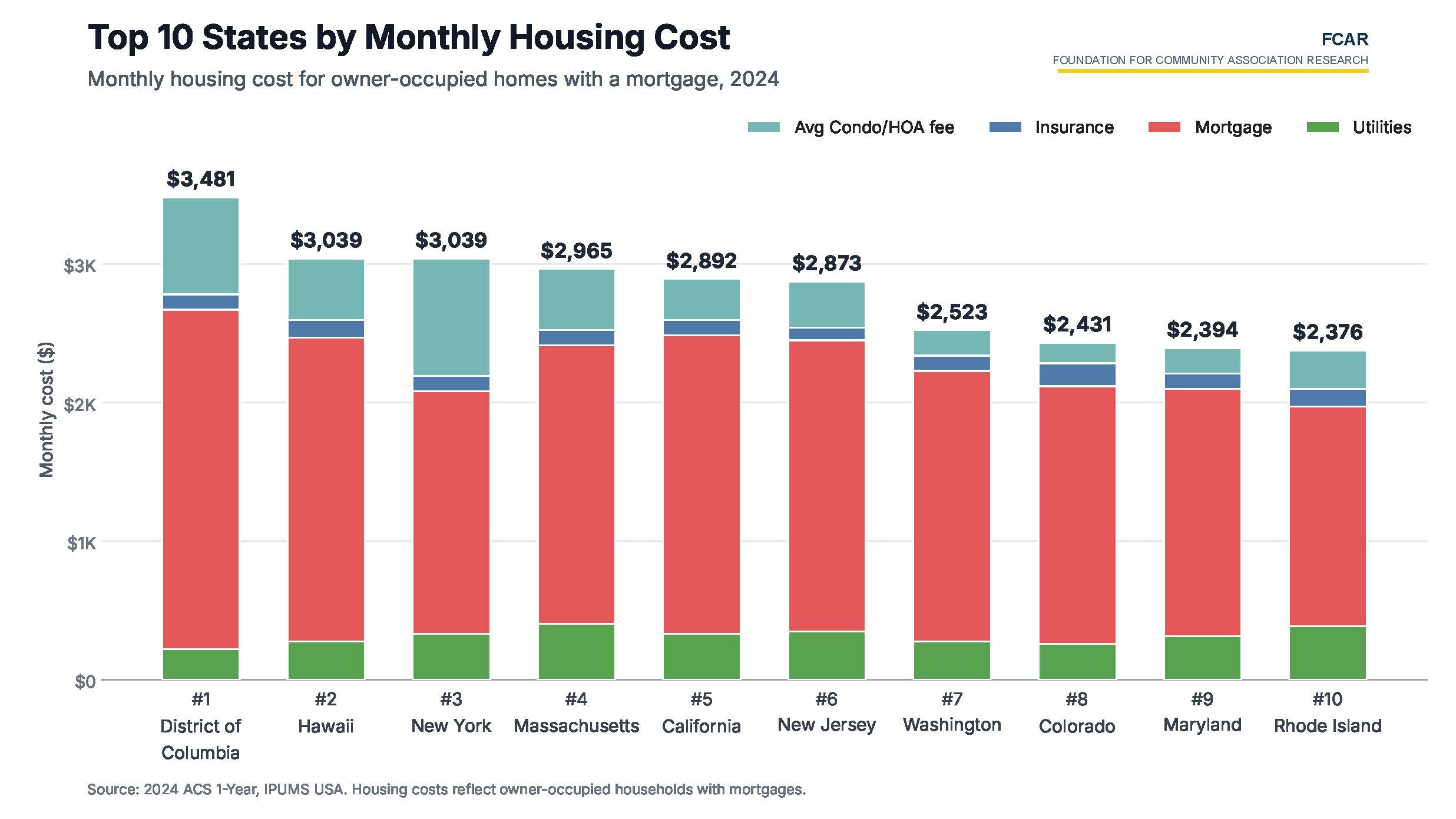
Housing costs vary significantly across the United States, reflecting differences in mortgage payments, insurance, utilities, and condominium or homeowners association assessments. The Foundation for Community Association Research’s interactive dashboard examines these expenses at the state level, providing insights into both the combined cost of homeownership and the financial burden of housing expenses relative to household income.
Explore the two interactive maps to compare housing costs and affordability across states. Select a state to view detailed statistics, examine individual cost components, and better understand how housing expenses relate to household income. Definitions, data sources, and methodology are provided below the dashboard.

How to Use the Dashboard: Select a state on the map to explore detailed housing cost and affordability statistics. Use the tabs to switch between Total Housing Cost and Housing Cost Burden. Hover over states and charts for additional information.
Dashboard User Guide
Explore our eight-page Dashboard User Guide for step-by-step instructions, key research findings, and explanations of the data sources and methodology.
Understanding the Data
The dashboard combines U.S. Census Bureau housing and household income data with community association estimates from the Foundation for Community Association Research. The following definitions explain the measures presented in the interactive maps.
Housing Costs
Total Housing Cost: A composite estimate of monthly housing expenses for homeowners with a mortgage, calculated by adding the individual cost components shown in the dashboard. Because these components use a combination of median and average values, the total may differ from the median monthly housing cost reported by the Census Bureau.
Mortgage Payments: Median monthly first and second mortgage payments among homeowners with a mortgage or loan. Payments may include escrowed property taxes and insurance.
Homeowners Insurance: Median monthly property insurance expenses paid separately from mortgage payments. Insurance already included in mortgage payments is excluded to avoid double counting.
Utilities: Median monthly expenses for electricity, gas, water, and other household fuels.
Condominium/HOA Assessments: The average monthly condominium or homeowners association fee among homeowners who report paying one. Unlike the other housing cost components, which use median values, this measure uses an average.
Housing Affordability
Housing Cost Burden: A statewide indicator of housing affordability, calculated by dividing the annualized median monthly owner cost for homeowners with a mortgage by the median annual household income of all owner-occupied households in the state. Higher percentages indicate greater housing costs relative to income.
Median Monthly Owner Cost (With Mortgage): The midpoint of monthly housing expenses among homeowners with a mortgage or loan, based on the Census Bureau’s owner-cost measure. This includes applicable mortgage payments, property taxes, insurance, utilities, and condominium or HOA fees.
Median Household Income: The midpoint of annual household incomes among owner-occupied households within a state, including homeowners with and without mortgages.
Understanding Housing Cost Burden: Housing costs exceeding 30% of household income are commonly used as an indicator of housing cost burden. However, the dashboard’s statewide percentage is calculated from two separate medians and does not represent the percentage of individual households that are cost-burdened.
Community Association Statistics
Homeowners Reporting Condo/HOA Fees: The percentage of owner-occupied households reporting monthly condominium or homeowners association fees greater than $0. This measure serves as a proxy for community association housing but may not capture every home located within a community association.
Total Community Associations: The Foundation for Community Association Research’s estimated number of condominium associations, homeowners associations, and housing cooperatives in each state, as reported in the Community Association Fact Book.
Data Sources & Methodology
Data Sources: Housing cost, household income, and condominium/HOA fee statistics are derived from the U.S. Census Bureau’s 2024 American Community Survey (ACS) 1-year estimates, accessed through IPUMS USA. Community association estimates are provided by the Foundation for Community Association Research.
Population and Geographic Coverage: The analysis covers owner-occupied households in all 50 states and the District of Columbia. Housing cost components are calculated for homeowners with a mortgage or loan, while selected income and community association fee measures include all owner-occupied households.
Calculating Total Housing Cost: Total Housing Cost is calculated by adding four monthly housing cost components: mortgage payments, homeowners insurance, utilities, and condominium/HOA assessments. Mortgage, insurance, and utility costs are weighted medians among homeowners with a mortgage or loan, while condominium/HOA assessments represent the weighted average among homeowners reporting a fee. Because these components are calculated separately and use different statistical measures, their sum is a composite estimate rather than the median total housing expense of an individual household.
Calculating Housing Cost Burden: Housing Cost Burden is calculated by multiplying the median monthly owner cost for homeowners with a mortgage by 12, dividing by the median annual household income of all owner-occupied households, and multiplying by 100. This ratio compares two statewide medians drawn from different homeowner populations and should not be interpreted as the actual share of income spent on housing by an individual household.
Housing Cost Components: Mortgage payments, separately billed homeowners insurance, utilities, and condominium/HOA assessments are calculated from ACS housing expense variables. Insurance included in mortgage payments is excluded from the separately billed insurance component to avoid double counting. Property taxes are included in the Census owner-cost measure used for Housing Cost Burden but are not displayed as a separate component in Total Housing Cost.
Community Association Fee Reporting: The ACS combines condominium and HOA fees into one variable. The percentage of homeowners reporting fees is therefore used as an indicator of community association participation, rather than a comprehensive count of all homes within community associations.
Statistical Methods: State-level statistics are calculated using ACS household weights to represent the broader population. Median values represent the midpoint of the weighted distribution, while average values represent weighted means.
Data Availability: Condominium/HOA fee data are unavailable for Connecticut, South Dakota, and New Hampshire in the underlying 2024 ACS dataset. As a result, the dashboard does not display HOA/condo fee amounts or Total Housing Cost estimates for these three states. Other available housing and affordability statistics remain accessible.
Interpreting the Results: The dashboard presents statewide estimates rather than the expenses or experiences of individual households. Housing costs, income, and community association measures may represent different populations or calculation methods and should be interpreted accordingly.
Sources: U.S. Census Bureau, 2024 American Community Survey (ACS) 1-Year Public Use Microdata, accessed through IPUMS USA; Foundation for Community Association Research, Community Association Fact Book.